

Conservation Guidelines are an important tool for heritage specialists and form the foundation for conservation reports and the design of interventions. Heritage buildings designated by the Federal Heritage Review Office (FHRO) typically include in-house Conservation Guidelines Reports, which outline the building’s history, an analysis of its architectural character, provides recommendations for a conservation approach ranging from overall site recommendations to specific materials or assemblies.
A precursor to a Conservation Plan, guidelines are intended to inform the conservation and design process at the Pre-Design phase, or often upon designation of a heritage building by an authority. Guidelines will assign high, medium and low heritage value to exterior and interior spaces after thorough review and research. This assessment of heritage value dictates the level of conservation required to uphold the building’s heritage value.
Sometimes assigning heritage value is more complicated than simply reviewing original building finishes or materials. Heritage value can be intangible and take form as relationships between spaces or experiencing a sense of scale. Maintaining these spatial relationships are integral to upholding the heritage value of a place, even as it experiences renovations throughout the decades.
At TRACE, we have experience both interpreting and authoring Conservation Guidelines.
Pre-Design Phase: Writing Conservation Guidelines
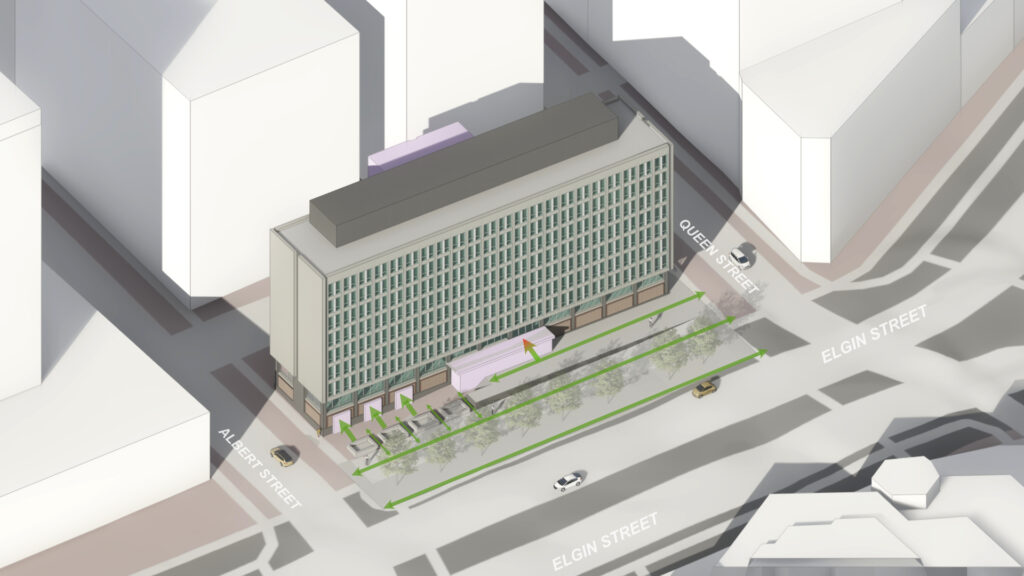
We have experience authoring Conservation Guidelines reports at the Pre-Design phase of projects approaching or seeking a heritage designation. These reports include substantive in-house research assisted by archives and site review, mapping or drawings existing and past conditions to understand spatial relationships and identifying character defining elements. A Heritage Character Statement may be included to inform heritage authorities with reasons for designation. Lastly, as part of the guidelines is assigning heritage value to spaces in a way that allows for sustainable change. Within these guidelines, high-level intervention guidelines are included to illustrate design possibilities that respect the Standards and Guidelines for Conserving Historic Places in Canada.
During Design and Construction: Interpreting Conservation Guidelines
As part of any heritage project, we become familiar with an existing Guidelines report to inform intervention decision-making and design process. In the form of a Heritage Conservation Approach (HCA) report, we compare the requirements of the guidelines to the design for the project, assessing the level of impact and providing mitigation measures to minimize negative impact to heritage value. During this process we wear both the designer and the heritage specialist’s hats, with a solution driven approach that can achieve compatible solutions.